
If you’ve spent any time on a bike, you’ve probably tried unclipping one foot to pedal single-legged. Within 45 seconds, your hip flexors burn, your pedaling gets jerky, and your body practically begs you to clip back in.
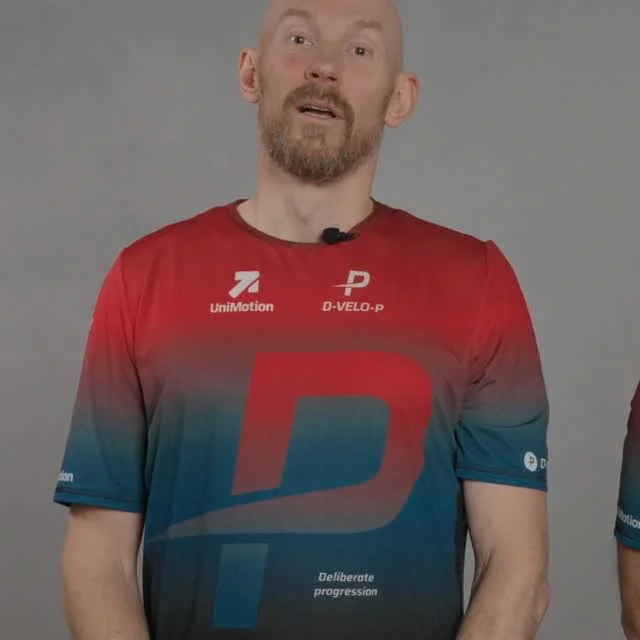
On a recent episode of the D-VELO-P cycling training podcast, host Erik Åkesson sat down with coach Fredrik Ericsson and engineer Stefan Eriksson to discuss Unipedaling—a training method designed to change how we think about pedal strokes, leg adaptations, and indoor training efficiency.
What is Unipedaling?
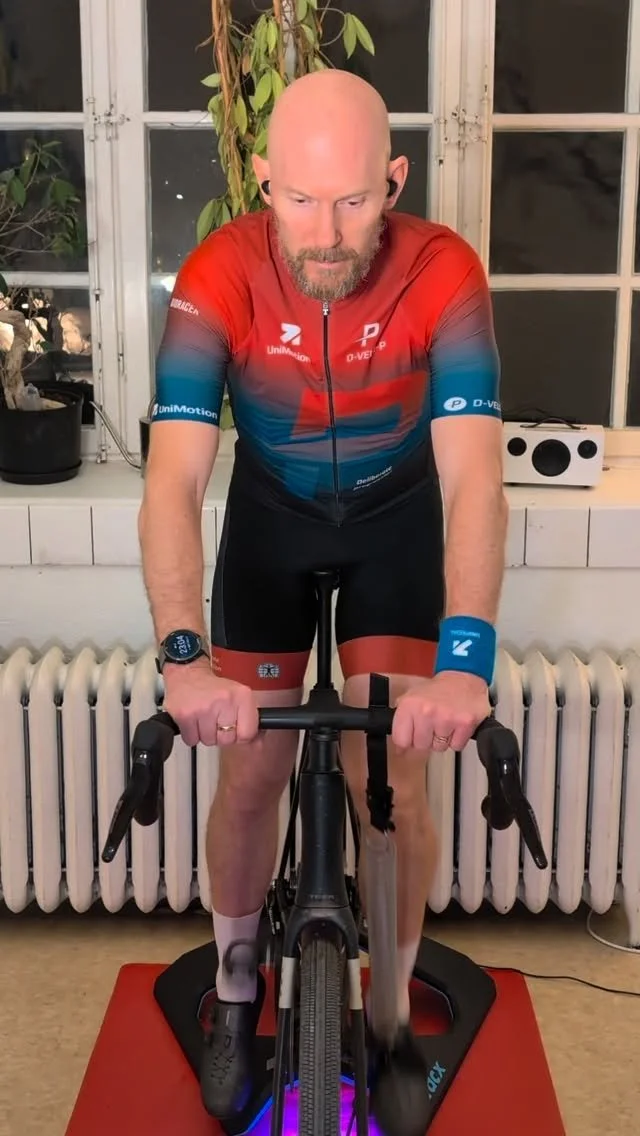
At its core, unipedaling is assisted single-leg pedaling.
Instead of straining to lift the deadweight of your leg on the upstroke, assistance (such as a spring-based attachment from the foot to the handlebar) helps pull the foot up. This makes single-leg pedaling feel smooth and sustainable, similar to normal two-legged riding.
The slogan behind the methodology: “Half is More.”
Half the muscle mass: Because only one leg is doing mechanical work at a time, your heart and lungs only need to deliver blood and oxygen to one side.
More muscular adaptations: Because central cardiovascular limits (heart/lung capacity) are no longer the bottleneck, the target leg receives a higher localized work load, triggering greater peripheral muscle adaptations.
The Science & Evolution: From Weights to Springs
While it sounds like a modern hack, research on assisted single-leg pedaling dates back decades:
1958 (Karolinska Institute, Stockholm): Researchers found that single-leg pedaling capacity was significantly higher than total two-legged capacity divided by two.
2000s (Dr. Jim Martin, Univ. of Utah): Academic studies explored single-leg pedaling using counterweights attached to the opposite pedal.
2015 Field Testing (Sierra Nevada): Fredrik Ericsson brought counterweight unipedaling to an altitude camp with elite riders (including Jenny Rissveds and Emil Lindgren), resulting in a 10% increase in 5-minute time trial performance.
The Engineering Breakthrough
For years, the main barrier to unipedaling was hardware complexity. Early systems relied on heavy counterweights (10–15 kg) or complex crank setups that required unscrewing components to switch legs.
In 2023–2024, engineer Stefan Eriksson shifted the approach: instead of pulling down on the opposite pedal with a weight, why not use a spring attached from the pedaling foot up to the handlebar? This eliminated bulky hardware, making the system lightweight, portable, and adaptable to standard indoor setups.
Primary Benefits & Adaptations
When training with unipedaling, adaptations are primarily peripheral (inside the active muscle tissue):
Enhanced Mitochondrial & Capillary Density: Higher local muscle strain triggers classic endurance signaling (mitochondrial biogenesis and increased capillary beds).
Aerobic Hyperpower: Riders can achieve higher absolute power output per leg than is possible during two-legged riding at the same relative cardiovascular strain.
Left/Right Balance Awareness: Clean, single-leg power tracking exposes structural output imbalances between your left and right legs.


Who Is It For?
Unipedaling isn’t just for elite cyclists looking for that final marginal gain:
High-Performance Athletes: Cyclists, triathletes, sailors, cross-country skiers, and ice hockey players who benefit from a higher intensity leg loading than their cardiovascular system normally can sustain.
Altitude & Heat Training: When training in hot or high-altitude environments, central oxygen transport is limited. Unipedaling allows high muscular loading despite heat or altitude stress.
Rehabilitation & Asymmetry: Riders recovering from single-leg injuries can maintain cardiovascular conditioning and retrain the injured side progressively.
Clinical & Fitness Populations: Patients with COPD, heart failure, or Type 2 diabetes can train leg muscles effectively without placing excessive strain on their heart and lungs.
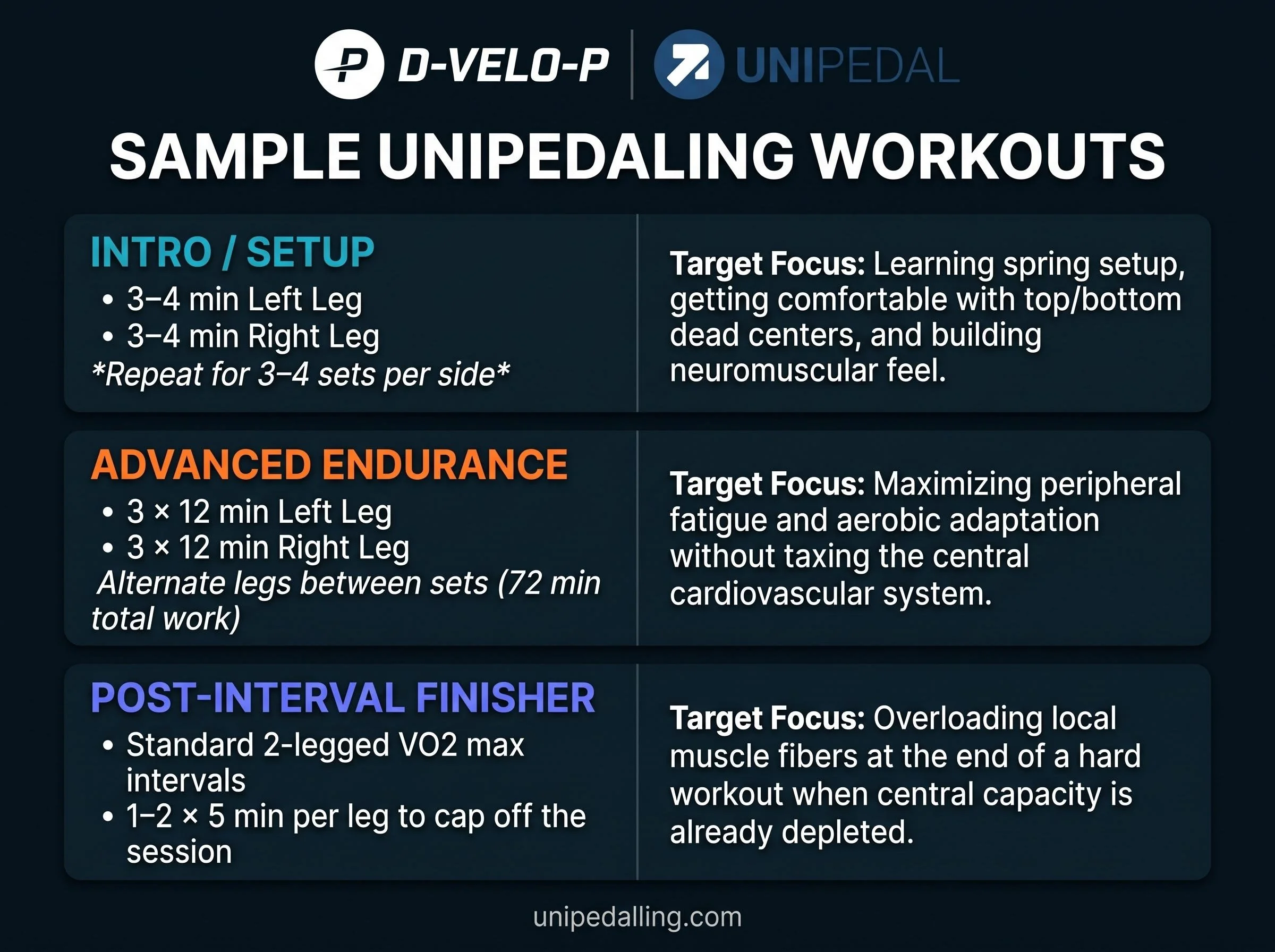
How to Structure a Unipedaling Session
Unipedaling is typically performed indoors on a stationary trainer for safety and stability.
Summary
Unipedaling turns traditional cycling training inside out: by loading one leg at a time with spring assistance, you bypass your cardiovascular limits to build stronger, more resilient endurance muscle locally.
Whether added to winter base blocks, combined with indoor heat workouts, or used for rehab, assisted single-leg pedaling offers an efficient tool for serious training.
