
Beyond the New Year’s Resolution: A Goal-Setting Guide for Continuous Growth
Welcome to the start of a new year—the perfect time to talk about goal setting. While the “New Year, New Me” mantra often fades, we believe goal setting should be a continuous, year-round system that keeps you on track. It’s about setting goals now and following up on them throughout the year, revising and reviewing as needed.

The Three Types of Goals we use as a framework that breaks down goals into three categories:
Result Goals: These are focused on outcomes, like winning a competition, finishing in the top 10, or qualifying for an event (e.g., finishing a race in under a certain time).
Strength: They provide strong motivation and a clear, high-level direction.
Challenge: They are highly dependent on external factors and the performance of others, making them difficult to control.
Performance Goals: These define how well you need to perform to achieve your desired results.
Examples: Maintaining 5 watts per kilo for 20 minutes, or executing a technical skill perfectly every time.
Strength: They offer more precise direction than result goals and are based purely on your own efforts.
Challenge: It can be tricky to determine the exact performance metrics needed to maximize your chances of achieving a result goal, introducing complexity and uncertainty.
Process Goals: These are the concrete, daily actions, routines, or systems required to achieve your performance goals. This is where the magic happens.
Examples: Getting an extra hour of sleep, increasing your total training volume, practicing a specific pedaling technique.
Strength: You have almost 100% control over these goals, and research shows they have the largest effect on performance compared to the other two types.
Challenge: The uncertainty lies in knowing which specific process goals will be the most effective.
The SMART(A) Goal Framework
To ensure your goals are well-formulated and effective, we recommend the SMART framework, sometimes with an added ‘A’ for SMARTA:
S - Specific: While a study suggests being super specific might not be as critical as previously thought, having a clear focus is still important.
M - Measurable: Goals must be measurable so you can track progress and development. As the saying goes, “The best way to change long-term behavior is short-term feedback.”
A - Attractive: The goal should be something you want to achieve and are inspired by. Focus on attaining something (positive behaviors) rather than avoiding something (negative ones) for greater success.
R - Realistic: Set goals that are achievable based on your commitment and capabilities. Unrealistic “dream goals” can lead to discouragement.
T - Time-bound: Goals need a defined time frame for achievement, which helps with motivation (e.g., this year, this quarter, this Olympic cycle). Ensure you have both short-term (a few weeks) and long-term (five years) goals, and even a start date for when you’ll begin focusing on a goal.
A - Accepted: The goal must “land in your heart,” not just your mind. You need to truly believe in it and be invested in its success.
Prioritizing and Identity
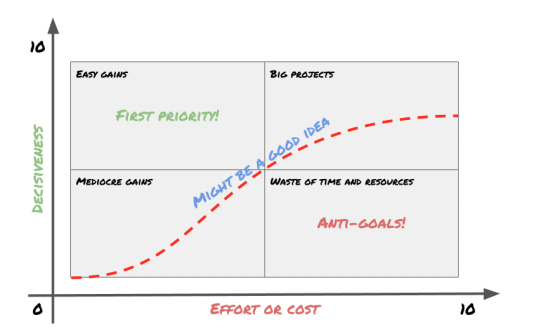
Prioritize: It’s easy to create a long list of goals. You must prioritize and dial it down to a few truly effective ones. A good approach is the Four Quadrant Graph (decisiveness vs. effort/cost) to find your “low-hanging fruit” (very decisive, low-effort goals).
Athlete Prioritization (A, B, C Races):
C-Races (Lowest Priority): Included as part of the training, no change to training plan.
B-Races (Mid-Priority): Lower intensity for a day or two before, maybe an extra rest day afterward. Sustains good performance.
A-Races (Highest Priority): The peak event you are truly training for.
Identity: Tie your goals to the type of person you want to be. Envision or embody a role model. As author James Clear says: “Decide the type of person you want to be and prove it to yourself with small wins. And every action you take is a vote for the type of person you wish to become.”
Our Goals for 2026
For our business, D-VELO-P, we have set the following goals:
Performance & Result Goals:
Continue producing the podcast D-VELO-P cycling training podcast weekly throughout 2026 (52 episodes).
Develop a more international brand for cycling coaching.
Continue our streak of hosting current and prior World Champion guests.
Process & Development Goals:
Develop continually as coaches (through preparation, conversations, and learning from guests).
Increase consulting work.
Give more lectures (both online and in-person).
Market the company more internationally.
Start a new podcast concept: Reviewing listeners’ training and goals on an episode.
If you’re interested in a lecture or would like us to review your training, feel free to reach out to us via E-mail: admin@d-velo-p.me or va leaving a comment on this post! We hope this guide helps you make 2026 a year of continuous, meaningful progress.