
For a long time, our (D-VELO-P’s) traditional approach to heat adaptation in endurance sports was simple: Go out, put on extra layers, cook yourself, but try not to overcook yourself.
If that sounds imprecise, it’s because it was.
In a recent episode, we sat down with Brian Maiorano from CORE to unpack how real-time biofeedback is turning heat training into a precision science—and why the benefits extend far beyond just preparing for a scorching race day.
Here are the key takeaways every athlete and coach should know about thermoregulation, hemoglobin gains, and periodization.
Listen to the full conversation here:
1. The CORE Sensor: Estimating Core Temp via Heat Flux
The CORE sensor didn’t start as a consumer sports gadget. Its core technology—the heat flux sensor—was originally designed to measure thermal energy transfer and calibrate high-precision lasers.
When translated to human performance, the sensor measures three distinct variables:
Heat flux data (heat leaving the body)
Skin temperature
Heart rate (paired from a chest strap or arm monitor)
By running these three metrics through an algorithm trained on real ingested e-pill data (swallowable core-temp capsules), Core generates a continuous estimate of core body temperature without invasive measurement tools.
2. Why Do Heat Training If You’re Not Racing in the Heat?
While triathletes racing in Kona or trail runners out for 20+ hours obviously need heat adaptation, road cyclists and endurance athletes in cooler climates are increasingly adopting heat training for a different reason: Hemoglobin and plasma volume gains.
When you undergo consistent heat stress, your body expands its blood plasma volume to provide more fluid for sweating and cooling. Following this plasma expansion, the body naturally produces more hemoglobin to maintain hematocrit balance.
The Result: Increased oxygen delivery capacity to working muscles, yielding performance benefits similar to altitude training.
The GI Tract Benefit: Heat causes the body to divert blood away from internal organs toward the skin for cooling. In ultra-endurance running, unmanaged heat surges shut down the digestive system, leaving unabsorbed fuel sitting in the gut. Heat training helps preserve gut integrity and digestive capacity under stress.
3. The Heat Strain Index (HSI): Moving Beyond Core Temp Alone
Focusing solely on core body temperature can be misleading.
On a cool 15°C day, a time trialist can push core temp over 40°C while feeling relatively comfortable because low skin temperatures allow rapid heat dissipation.
Conversely, on a hot 30°C day, a core temp of just 38.5°C feels brutal because high skin temperature prevents heat loss.
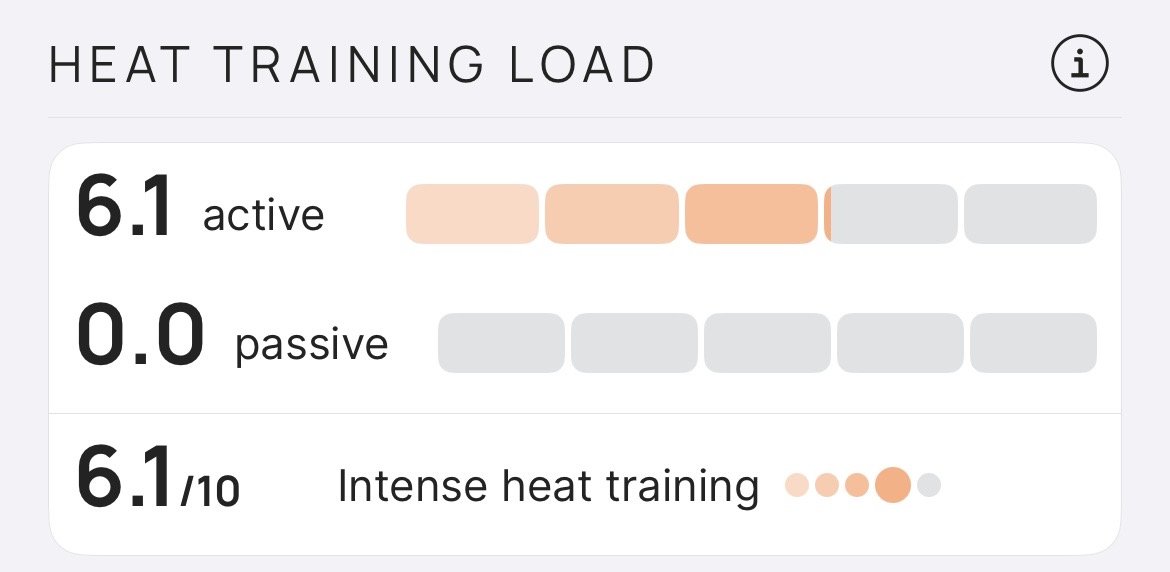
To solve this, CORE introduced the Heat Strain Index (HSI)—a zero-to-ten real-time score calculated from mean body temperature principles:
0 – 3.0 (Green Zone): Low heat stress. Ideal for racing without thermoregulatory performance decay.
3.0 – 7.0 (Training Sweet Spot): The optimal range for heat adaptation without inducing excessive, non-productive fatigue.
7.0+ (Red Zone): High thermal load. Offers no extra physiological adaptation while drastically compounding system fatigue and recovery time.
4. Practical Protocols for Beginners & Seasoned Athletes
A. The Post-Interval “Heat Suit” Hack
Instead of spending 90 minutes suffering at high power in a heat suit, do your standard interval session with fans running full blast to hit your target wattages. Once completed:
Turn off the fans.
Put on extra clothing or a heat suit.
Spin easy in Power Zone 1/Zone 2 for 30–45 minutes.
Because your core temperature is already elevated from intervals, your skin temperature will spike within 5–10 minutes, rapidly bringing you into the HSI sweet spot (3.0–7.0) with minimal mechanical load.
B. Heat as a Tool for Muscular Recovery
During heavy training blocks, cardiovascular capacity can outpace muscular recovery. By adding thermal stress, athletes can ride at lower wattages (Zone 1 or Zone 2 power) while elevating their heart rate into threshold zones. This provides a high cardiovascular stimulus while giving legs a mechanical break. Triathlon coach Olav Alexander Bu wrote an excellent article about this on CORE’s blog: Read it here:
C. Maintenance & Periodization
Maintenance: Once adapted, maintaining hemoglobin gains requires as little as 3 heat sessions per week.
Altitude Stacking: Heat training before an altitude camp allows athletes to arrive at elevation with elevated hemoglobin, reducing the traditional 1–2 week “misery phase” when first training at height.
5. Hydration: Avoid the Dehydration Trap
Older training mythologies suggested that heat training while deliberately dehydrated yielded greater adaptations. Modern consensus advises against this. Excessive dehydration severely hampers post-session recovery and increases health risks.
Pre-load with lightly salted fluids/electrolytes before sessions.
Aim to absorb around 0.75L to 1.0L of electrolyte solution per hour during heat work.
Rehydrate immediately post-session to replace total fluid losses calculated by sweat-rate testing.
Summary
Heat training is no longer about blindly guessing how hot you feel—it’s an objective metric you can manage just like power, heart rate, or pace. By aiming for an HSI between 3.0 and 7.0 and keeping sessions controlled, endurance athletes can unlock plasma and hemoglobin boosts year-round.