
Fredrik’s Defense: Erik Grills the Training Decisions - reviewing his athletes training
The Handbrake Effect: Why One National Champion Had to Slow Down to Get Faster
In our latest podcast episode, we took a deep dive into the training data of Nellie Larsson, a Swedish National Champion in MTB Marathon. Nellie is the quintessential “busy high-performer”: she’s in her 40s, balances a full-time job and family, and yet remains a “beast” when it comes to aerobic endurance.
However, even champions have blind spots. Erik Åkesson “cornered” Fredrik Ericsson (who has been consulting with Nellie for almost a year and a half) on the coaching decisions made over the last year, revealing some fascinating insights into the risks of e-cycling, the trap of the “hardcore mentality,” and how to manage training when life gets in the way.
Thanks for reading! Subscribe for free to receive new posts and support my work.
The Profile: A Specialized Engine
Nellie is a powerhouse, particularly at the longer end of the spectrum. Her 2025 metrics showed:
20-minute Power: 4.8 W/kg
60-minute Power: 4.5 W/kg
Total Annual Volume: ~750 hours
While her aerobic base is world-class, her “Achilles heel” remains maximal explosive power—a common challenge for marathon specialists.
Analyzing the Performance Management Chart
Erik shared his screen to highlight Nelly’s Performance Management Chart (PMC), which tracks her fitness (CTL), fatigue (ATL), and form (TSB) throughout the year.
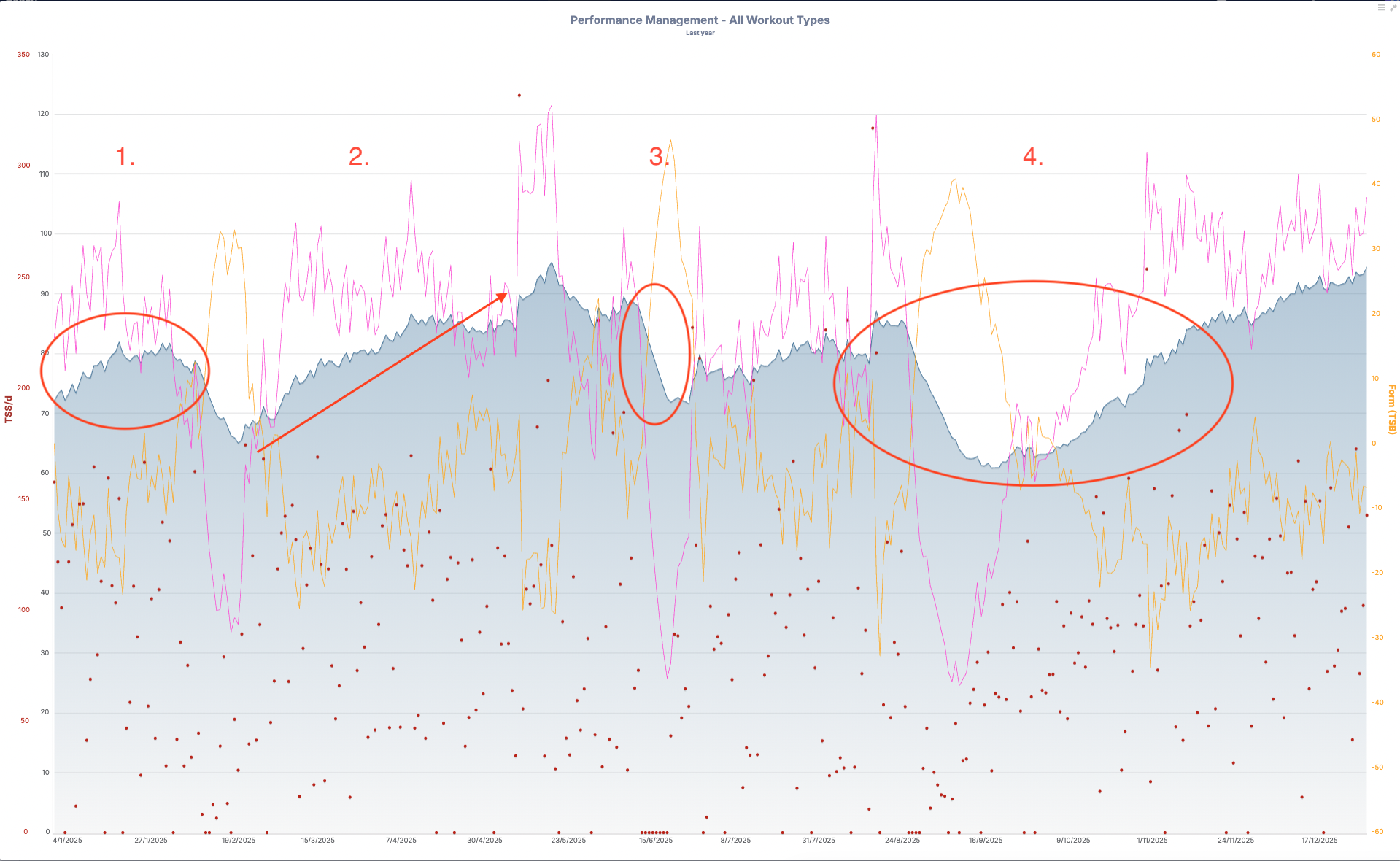
The chart reveals several critical periods:
The Early Year Fitness Gain: In January and February, Nelly maintained high intensity through e-cycling, but a common cold in late February caused a significant drop in her fitness metrics.
The Spring Surge: After transitioning to more outdoor riding and longer, continuous efforts in April, her fitness (the blue shaded area) began to rise steadily, reaching a peak toward mid-May.
The Mid-Summer Dip: The PMC shows a sharp decline in June due to another bout of sickness, right before the Swedish Marathon Championships.
The Late Season Recovery: Following a three-week illness in August—which required eight days of antibiotics—the chart shows it took nearly two months of consistent, structured training to return to her previous performance levels.
Deciphering the Intensity Factor (IF)
To understand why Nelly often felt like she was riding with the “handbrake on,” we looked at her Intensity Factor (IF) and weekly Training Stress Score (TSS).
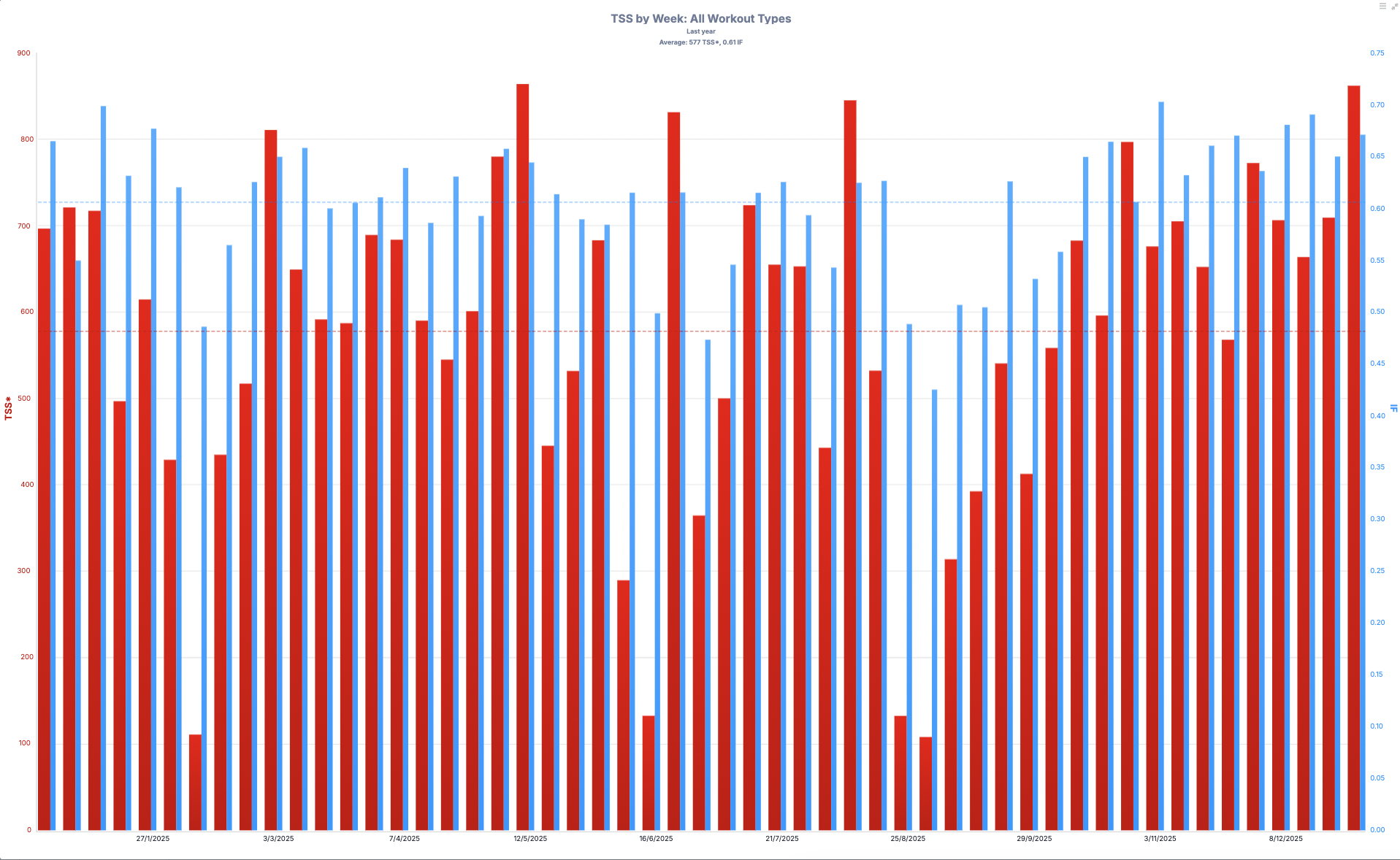
High-Intensity Congestion: The IF chart (blue bars) shows many weeks early in the year with very high intensity relative to the volume. Erik noted that combining multiple max-effort virtual races with low-carb long rides created a “washed” feeling in her legs.
The Shift in “Ingredients”: While the total weekly TSS (red bars) remained somewhat similar throughout the year (except the sickness weeks), the composition of that stress changed. Later in the year, the IF became more standardized. By “putting the screws down” on unstructured high intensity and focusing on themed blocks (like cadence drills), Nellie was able to handle a higher overall load with better recovery.
Consistency over Intensity: The chart illustrates that her most successful periods followed blocks where the TSS was high but the Intensity Factor was managed strategically, rather than being constantly “redlined” in virtual races.
1. The Trap of E-Cycling Intensity
One of the most striking parts of Nellie’s winter was the sheer density of Zwift and MyWoosh racing.
The Problem: Nelly was often doing 2–3 maximal efforts per week within the e-cycling ecosystem.
The Result: She often felt like she was riding with the “handbrake on.” Erik pointed out that her heart rate zones were likely set too high (161 bpm threshold vs. a 170 bpm max), leading to a misunderstanding of just how much stress she was under.
The Lesson: E-cycling is “always on.” There is no coasting. If you race online multiple times a week, you must treat those as your primary intervals and strip away other structured intensity to allow for recovery.
2. The Danger of “Pushing Through”
Mid-January and late summer both saw Nellie flirting with illness. Like many dedicated athletes, her instinct was to push.
“We know it from education and experience, yet we still fall into the trap,” Fredrik admitted.
Nellie attempted high-intensity intervals while feeling “on the limit” of a fever. This eventually led to a crash in form and a three-week bout of sickness requiring antibiotics.
Takeaway: A missed session is a minor setback; a month of antibiotics and “heavy legs” is a season-ruiner. If you feel a scratchy throat, the only interval you should be doing is an interval of sleep.
3. “Low-Carb” Spicing and Strategic Heat
With a full-time job, Nellie’s long rides are capped at about 3–4 hours. To simulate the metabolic stress of a 6-hour marathon, Fredrik implemented low-carb long rides.
The Critique: Erik noted these were sometimes placed the day before a high-intensity Zwift race, leading to “washed” legs.
The Adjustment: We’re moving toward more structured periodization. Instead of “a little heat training here and there” or “random low-carb rides,” we are focusing on themed blocks.
4. The “Magic” of the Outdoor Switch
The most positive shift in Nellie’s data occurred in April. By moving away from the “micro-burst” nature of e-cycling toward long, steady climbs on her mountain bike, her performance skyrocketed.
She matched her 2021 PRs (the year she won Nationals).
Why? The steady, high-torque nature of outdoor climbing suited her physiology better than the “on/off” spikes of virtual racing.
The Verdict: Less is More
As Nellie moves into 2026, the focus is shifting. We are replacing some of that raw intensity with cadence drills.
Low Cadence (40–60 RPM): To build specific torque and leg strength.
High Cadence (100–120 RPM): To improve neuromuscular efficiency and “adaptability” in the pack.
The big takeaway for every listener: You can’t just keep adding (more volume, more heat, more low-carb, more racing). To add something new, you usually have to take something away.
Do you want your training dissected?
We are looking for more listeners to analyze. If you’re willing to let us look under the hood of your TrainingPeaks, email us at info@develop.me.
Until next time, keep the rubber side down.