
Van der Poel, Klaebo, and You: Stealing Olympic Pacing Secrets for Your Next Ride.
In our latest episode of the D-VELO-P Cycling Training Podcast, we sat down to dissect a brand-new study published in the Scandinavian Journal of Medicine & Science in Sports (January 2026).
While the paper focuses on the endurance events in Milano Cortina 2026 Winter Olympics, the lessons on pacing are universal—whether you’re navigating a slushy ski climb in Italy or a technical mountainbike single track in Spain.
If you want to read the whole article, it is availible open-access here: https://doi.org/10.1111/sms.70215Digital Object Identifier (DOI)
What is pacing?
The authors explains “pacing” from a physiological perspective:
“Effective pacing reflects the interplay between aerobic and anaerobic energy systems, fatigue resistance, thermoregulatory control, and neuromuscular coordination. Athletes must optimize energy distribution and preserve mechanical efficiency across varying race demands.”
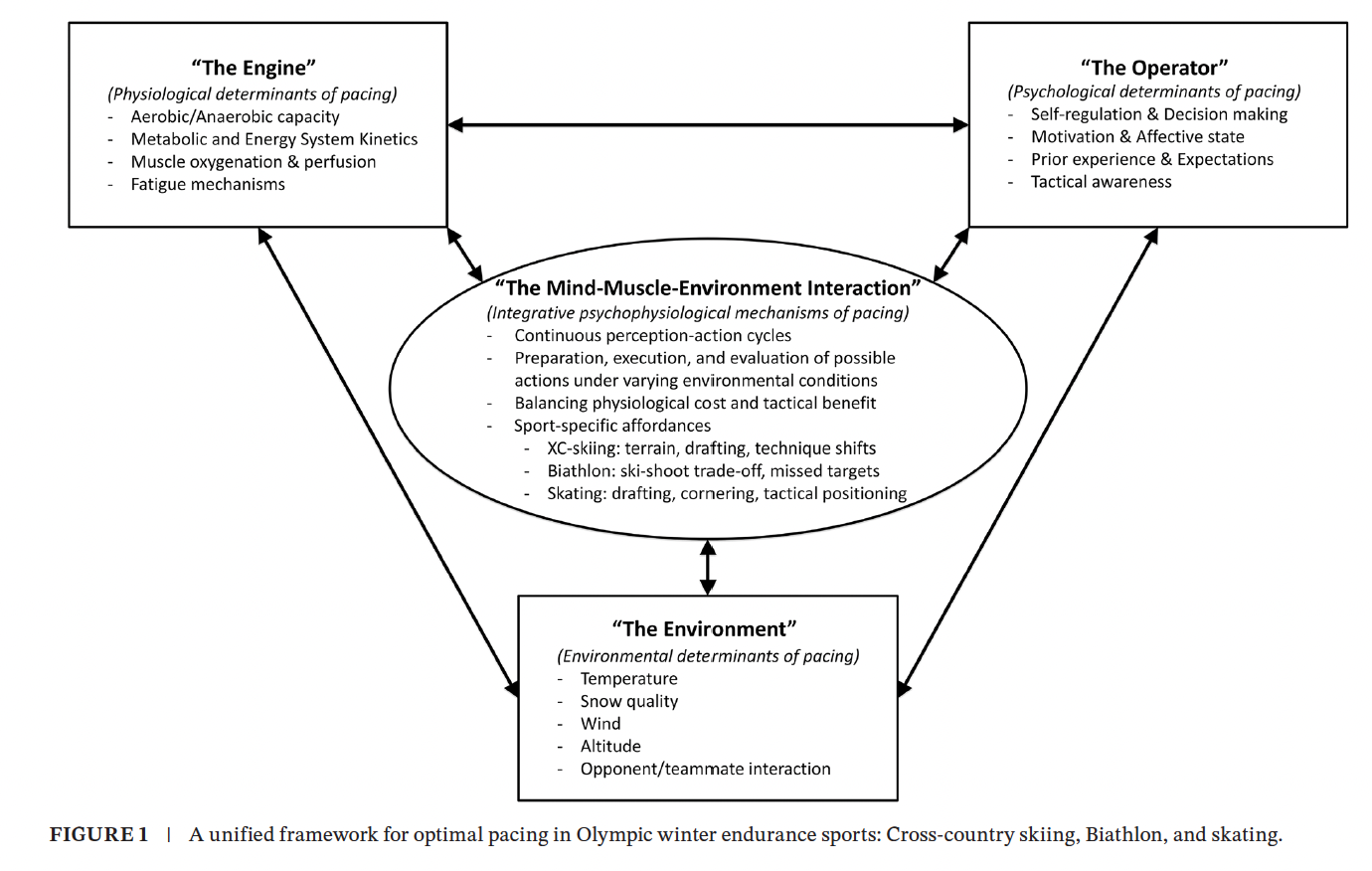
The “Mind-Muscle-Environment” Model
Historically, pacing research was a bit one-dimensional, focusing mostly on how to get from point A to point B without blowing up. But this new study introduces a more holistic framework that we believe every endurance athlete should adopt. And of course, being cycling coaches, we take the goodies from the study back to cycling:
The Muscle (The Engine): Your aerobic/anaerobic capacity, energy and metabolic system kinetics, muscle oxygenation, glycogen stores, and fatigue mechanisms.
The Mind (The Operator): Your self-regulation, attention, decision-making, motivation, prior experience, expectation and emotional state.
The Environment (The Context): Temperature, wind, altitude, snow conditions, and—crucially—how your opponents are behaving.
Lessons from the Ice and Snow
We often think of pacing as a “steady state” endeavor, but the Winter Olympics show us otherwise:
The “Van der Poel” Effect: In long-track speed skating, most athletes fade (a “positive split”). However, legends like Nils van der Poel proved that a negative split (finishing faster than you start) is often metabolically superior for events longer than two minutes.
The Downhill Trap: In cross-country skiing, athletes spend over 50% of their time going uphill. The study warns that “excessive power output on uphills may lead to fatigue that impairs downhill technique.” We see this in mountain biking constantly—if you redline the climb, you’ll likely crash or lose time on the descent because your brain lacks the “operating power” to pick a good line or maintain speed.
Pacing is a “Use It or Lose It” Skill
One of the most striking points we discussed is that pacing isn’t just a physiological trait—it’s a perceptual skill that requires constant maintenance.
“If you don’t do a 7-minute all-out effort for six months, you’re basically back at ground zero when it comes to your ‘feel’ for that duration.” — Fredrik Ericsson
To master this, we recommend the Self-Regulation Cycle:
Plan: Set a power or effort target based on the terrain.
Monitor: Listen to your body and the environment (e.g., “I just hit a headwind, I need three hard strokes to maintain momentum”).
Evaluate & Reflect: After the session, check your data. Did you fade? Did you have too much left in the tank?
Key Takeaways for Your Next Ride
Ditch “Erg Mode” Occasionally: While convenient, riding in a fixed power mode robs you of the chance to practice “micro-pacing” against simulated terrain and wind.
Experience Matters: Younger athletes almost always start too fast. If you’re a veteran, use your “pacing maturity” to catch the “rabbits” who blow up halfway through.
The Environment is Tactical: Pacing in a mass start isn’t just about watts; it’s about positioning. Sometimes the “hardest” part of the race is the 30 seconds before a technical section.
Listen to the full episode on the D-VELO-P Podcast for a deeper dive into Olympic strategy and how Erik is planning to pace his upcoming 83km Marathon World Cup in Spain.