
The Breath Holding Enigma: Can Holding Your Breath Really Boost Your Athletic Performance?
A discussion of: The Application of Breath Holding in Sports: Physiological Effects, Challenges, and Future Directions—a study from the European Journal of Applied Physiology (2025).
Link to the full article: https://link.springer.com/article/10.1007/s00421-025-05752-y
Listen to our whole discussion in episode 16 of D-VELO-P cycling training podcast linked on the Spotify icon below
Breath holding has been studied in sports for nearly a century, but there’s still no clear consensus on how to use it effectively as a training method. Here is a breakdown of our discussion on the short-term and long-term effects.
Acute/Short-Term Effects: The Warm-Up Prime
The primary theory for using breath holding in a warm-up is to “prime” the body by triggering the spleen.
The Spleen Effect: Holding your breath to your maximum capacity (3-5 times) can cause the spleen to empty its extra pool of hemoglobin, temporarily increasing the blood’s oxygen-carrying capacity. This effect lasts about 10 minutes.
The Challenge: This is highly taxing, both physically and mentally fatiguing.
Conclusion: The studies reviewed found the short-term results to be largely non-conclusive for performance gains. In a 4km time trial study, the breath-holding group was worse in the first kilometer, likely due to mental fatigue, when they ended the maximal breath-hold 30-45 seconds before the start. In practice, sticking to a normal warm-up is likely the easier, more reliable choice.
Long-Term Effects: The Promising Pathways
The long-term (over five weeks) effects of breath-holding training show more promising, though still inconclusive, pathways for performance gains:
Psychological Resilience: Breath holding forces athletes to endure significant discomfort, which builds psychological resilience—a trait strongly linked to success in all sports (often related to stoicism or grit). It provides the mental quality training of a tough physical session without the high physiological load.
Hypercapnia & Tolerance: The training can improve your ability to tolerate higher doses of carbon dioxide (hypercapnia) in your blood. This psychological and potentially physiological adaptation could make you tougher in the end stages of a hard effort, like a sprint.
Skeletal Muscle Capillarization: Long-term training may improve blood-to-tissue exchange capacity (capillarization), a key adaptation for endurance sports.
Hematological Effects (Natural EPO): Breath holding has been shown to naturally elevate Erythropoietin (EPO) concentrations, similar to what is attempted with altitude or heat training, making it a safer alternative to intermittent hypoxic masks.
Dynamic vs. Static: The discussion concluded that dynamic breath holding (while cycling, running, etc.) seems to show the most potential, though static breath holding (while resting) still seems to be good, especially for the effects on the blood.
A Note on Sprinting & Stroke Volume
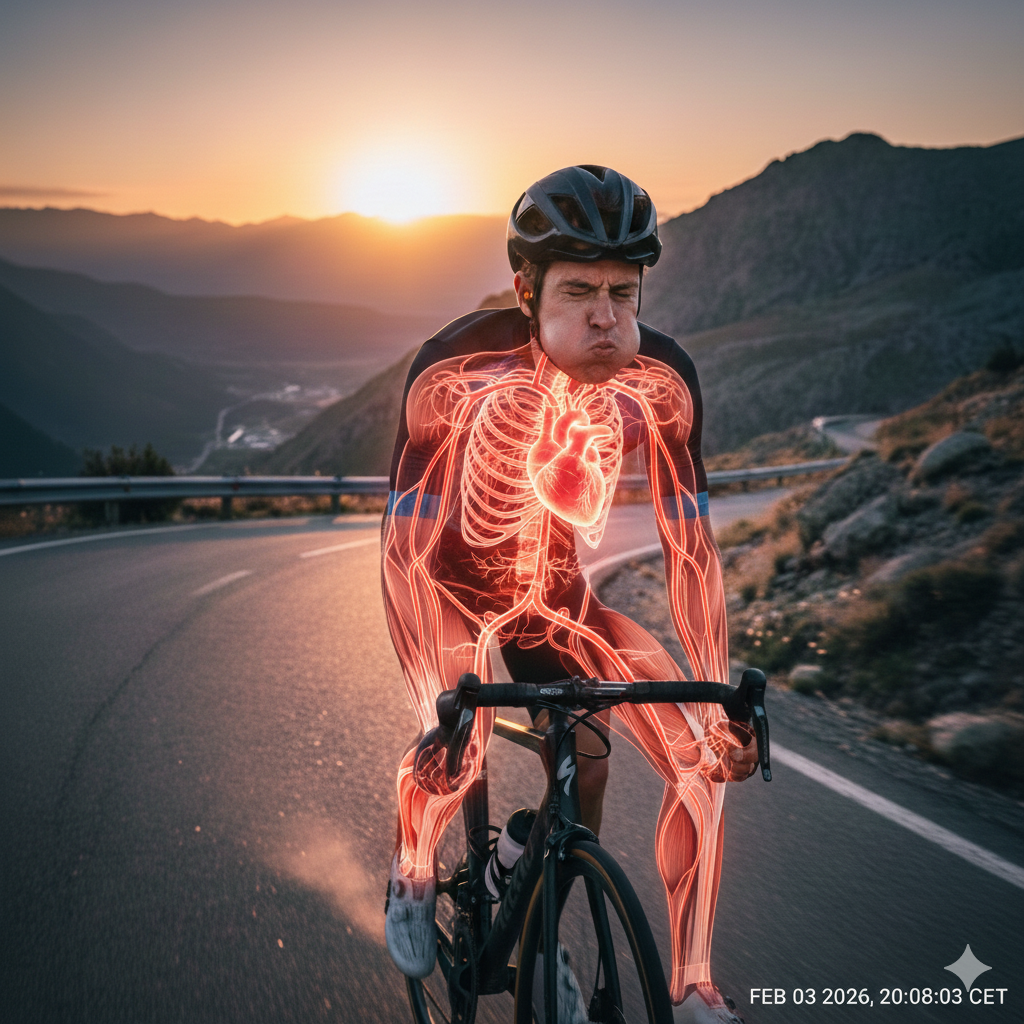
We also discussed an older, unreferenced study (from around 2021) that showed a remarkable 31% increase in stroke volume from max-exhale breath-hold sprints (sprinting for 4-8 seconds with no air in the lungs), called APNEA-sprints. This suggests exhaled breath-hold sprints could be a great training stimulus for the heart, which might be a potential reason for performance gains seen in some sprinting-related studies.
Safety and Practical Advice
The practice appears to be quite safe, with no adverse effects on cardiac health or vascular integrity. However, it is essential to be cautious to avoid injury if you do push to the point of blacking out (e.g., do it while lying down). If you are considering this type of training, especially for hematological effects, it’s recommended to invest in a pulse oximeter (which can be quite cheap—$30-$40 for a basic one) to measure your blood oxygen content. You need to hold your breath long enough to see a significant drop in oxygen concentration to achieve the desired effect.